Can AI apply to jobs for me?

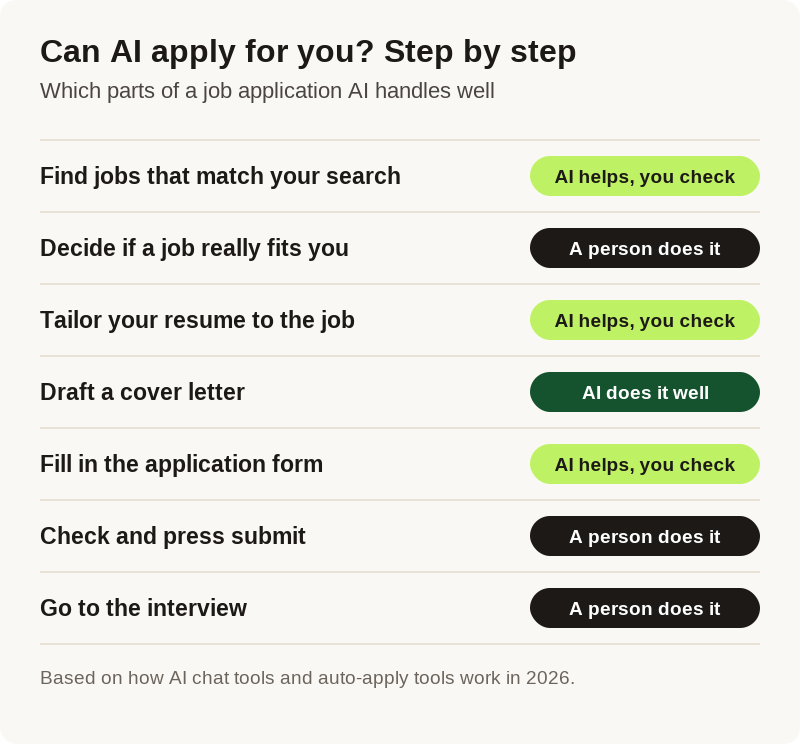
Partly. AI auto-apply tools can fill in and send applications for you, sometimes hundreds a month. Chat tools like ChatGPT and Claude can write your resume and cover letter drafts, and their browser agents can fill in simple forms while you watch, but they can't reliably run your applications on their own.
The bigger question is whether you should let AI apply unchecked. Sending lots of untailored applications to jobs you don't fit rarely leads to interviews. AI works best when it does the busy work and a person decides which jobs to apply to and checks what gets sent.
What AI can do in a job search
AI is genuinely useful for the slow, repetitive parts of applying. It can read a job description and pull out the skills that matter, suggest which of your achievements to move up, draft a cover letter in seconds and fill in the same details on form after form.
Where it struggles is judgment. It can't tell whether a role really fits your experience, whether the company is hiring in your country, or whether the job was posted three months ago and is already filled. Those calls decide whether an application gets a reply.
Can ChatGPT apply to jobs for me?
Not on its own in a normal chat. ChatGPT can write and tailor your resume, draft cover letters and answer application questions, but you still copy them into each job site and press submit.
Its agent mode can open a browser and fill in some forms while you watch. In practice it often stops at logins, CAPTCHAs, file uploads and long applicant tracking systems like Workday, so it's slower than doing it yourself for most jobs. Treat it as a helper, not something that runs your search.
Can Claude apply to jobs for me?
The same is true for Claude. It's good at reading a job description against your resume and rewriting your bullet points honestly. With a browser extension it can fill in forms in your own browser, but it asks you to check before submitting and it isn't built to apply unattended.
Whichever chat tool you use, read every tailored resume before you send it. AI tools sometimes add skills or numbers you never gave them, and an employer will ask about them in the interview.
What AI auto-apply tools do
Auto-apply tools are services built for one job: sending applications for you. You set your job titles, locations and salary, upload a resume, and the tool finds matching jobs and applies, often 20 to 100 a day. Prices usually run from about $20 to $200 a month.
The catch is that matching is done by keywords. A tool can't tell that a 'Marketing Manager' job at a 10-person startup is a very different role from one at a bank. Most tools also use one resume, or lightly edit it, so many applications look generic to the person who reads them. Some job sites, including LinkedIn, don't allow automated bots in their terms, so check before you connect an account.
Chat tools vs auto-apply tools vs a person
| AI chat tool | AI auto-apply tool | A person (reverse recruiter) | |
|---|---|---|---|
| Sends applications for you | No, you submit | Yes, in bulk | Yes |
| Checks each job fits | Only if you ask | Keywords only | Yes, reads each job |
| Tailored resume | If you prompt it | Rarely | For every job |
| You see what was sent | Yes | Sometimes | Yes, in a tracker |
| Typical cost | Free to $20 a month | $20 to $200 a month | $300 to $700 a month at Robiq |
The risks of letting AI apply for you
- Wrong jobs: applying to roles you don't fit wastes your best chances and can make recruiters remember you for the wrong reason.
- Made-up details: AI can add skills, tools or results you don't have. That's a problem the moment you're asked about them.
- Duplicates: the same job is often posted on several sites, and bulk tools can apply two or three times.
- Account limits: some job sites limit or block accounts that apply too fast or use bots.
- No record: if you can't see what was sent, you can't prepare when a recruiter calls.
A safer way to use AI in your job search
- Write down 2 or 3 target job titles, your level and locations before you use any tool.
- Use AI to shortlist jobs, then read each shortlisted job yourself, or have someone you trust read it.
- Use AI to tailor your resume for each job, then check every line is true.
- Let AI fill in the form, but review it before you press submit.
- Log every application with the job link and date, so you can follow up and prepare.
- After every 50 applications, look at your replies. If you're getting none, fix your targets or resume before you send more.
My advice
I'm not against AI. We use it every day to save time. But the biggest mistake I see is people sending hundreds of applications without checking whether the jobs are the right fit. Quality matters more than quantity, and a tool can't decide quality for you.
For one software engineer we worked with through a US recruiting agency, we narrowed his targets first and applied only to roles that fit. Within one month he had 35 interviews and a contract offer worth $150k a year. That came from a person checking every job, with AI doing the busy work in the background.
If you'd rather not do it yourself, that's what a reverse recruiter does. At Robiq, a one-time trial is $40 for 50 tailored applications, so you can see the work before you commit to a monthly plan.
Questions
Can AI apply to jobs for me automatically?
Yes, AI auto-apply tools can send applications for you in bulk. Chat tools like ChatGPT and Claude can't reliably apply on their own; they help you write and fill in applications while you check and submit.
Can ChatGPT apply to jobs for me?
Not by itself. It can tailor your resume and write cover letters, and its agent mode can fill in some forms while you watch, but it often stops at logins, CAPTCHAs and long application systems.
Can Claude apply to jobs for me?
Claude can rewrite your resume for each job and, with a browser extension, fill in forms in your own browser. It isn't built to apply unattended, and you should check everything before you submit.
Do AI auto-apply tools work?
They send a lot of applications, but results depend on fit. Because they match jobs by keywords and rarely tailor your resume, reply rates are often low. They suit high-volume, entry-level searches better than senior roles.
Can employers tell if AI applied for me?
Often they can tell when an application is generic, such as a resume that doesn't match the job or a cover letter with no real detail. A tailored, accurate application reads well whoever helped write it.
Is it allowed to use AI to apply for jobs?
Using AI to write and tailor your application is fine as long as everything in it is true. Some job sites don't allow automated bots in their terms, so check before you connect a tool to your accounts.
What's better, AI or a reverse recruiter?
AI is cheaper and fine for simple, high-volume searches. A reverse recruiter is better when fit matters, because a person reads each job and tailors your resume. Many people use AI for drafts and a person for targeting.