Getting no response from job applications? Here's why

Most people get no response from job applications for one of three reasons: they are applying to jobs that don't fit them closely enough, their resume doesn't make that fit clear in a few seconds, or they are applying too late, after the recruiter has already found a shortlist. Silence is common, but it is rarely random.
The fix is not to send more of the same. Stop, look at your own numbers, find the stage where applications get stuck, and change that one thing. Below are the 9 most common reasons and how to tell which one is yours.
Is it normal to hear nothing back?
Yes, sadly. Popular roles often get hundreds of applications, and hiring reports commonly say recruiters only reply to a small share of them. Many companies never send rejections at all. So one silent application tells you nothing.
A pattern does tell you something. If you've sent 30 to 50 well-matched applications over a few weeks and had no replies at all, not even rejections or recruiter calls, something in your approach needs to change.
9 reasons you're getting no response
- 1. The jobs aren't a close fit. You meet some of the requirements, but someone else meets all of them. This is the most common reason we see.
- 2. Your resume is generic. The same resume for every job makes recruiters guess whether you fit, and they don't have time to guess.
- 3. You apply too late. By the time a job is two or three weeks old, many recruiters already have a shortlist.
- 4. Your job titles don't match. If you're a 'Growth Lead' applying for 'Marketing Manager' roles, a quick skim or keyword search can miss you.
- 5. The applicant tracking system can't read your resume. Two-column designs, text in images and tables can scramble your details.
- 6. You're applying to the wrong level. Applying too senior gets ignored, and applying too junior can look like a poor fit too.
- 7. Location or visa rules rule you out. Many 'remote' jobs are open to one country only, and some roles can't sponsor visas.
- 8. Only cold applications. Applying through job boards alone, with no referrals or messages to people at the company, puts you at the back of the pile.
- 9. It isn't you. The job was filled internally, put on hold, or was never really open. You can't fix this one, which is why your overall numbers matter more than any single job.
Find your problem from your own numbers
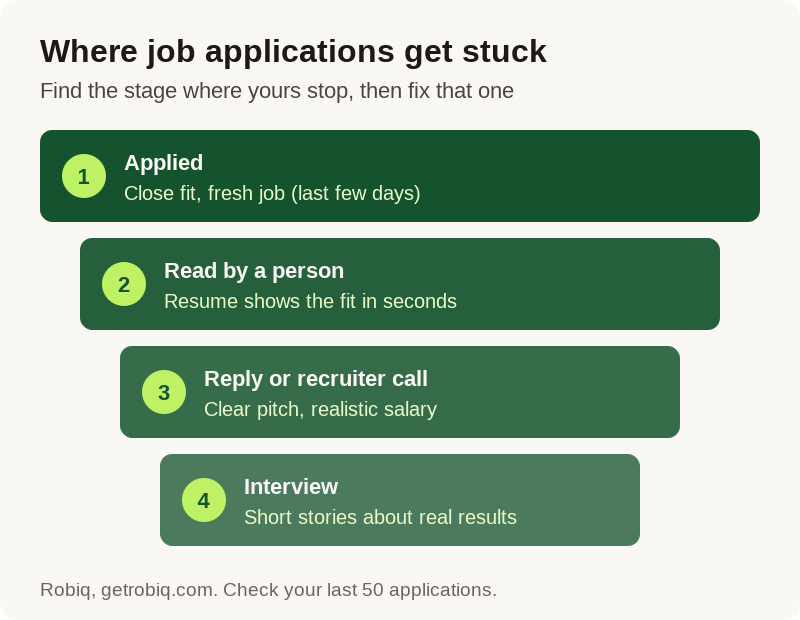
Look at your last 50 applications. Where they stop tells you what to fix.
| What's happening | What it usually means | What to change |
|---|---|---|
| No replies at all, not even rejections | Targeting or resume | Narrow your target roles and tailor your resume to each job |
| Fast automatic rejections | Missing must-have requirements, or the resume isn't read correctly | Apply only where you meet the must-haves and use a simple layout |
| Recruiter calls, but no interviews after | Your pitch or salary expectations | Practice a 60-second summary and research the salary range |
| Interviews, but no offers | Interview preparation | Prepare 5 short stories about results and practice out loud |
What to do this week
- 1. Pause new applications for a day or two. Sending another 50 the same way will get the same result.
- 2. Write down 2 or 3 target job titles, the level, the locations you can work in and whether you need sponsorship.
- 3. Rebuild your resume around those titles: headline, summary, skills order and top bullet points. Our guide to tailoring your resume to a job description shows how in about 20 minutes per job.
- 4. Switch to fresh jobs. Filter job boards to the past 24 hours or past few days, and apply early.
- 5. Skip jobs where you miss the must-haves. Fewer, better applications beat a long list of near misses.
- 6. For your top 5 jobs, message one person at the company: the hiring manager, someone on the team, or a recruiter.
- 7. Track everything for the next 2 weeks: date, job link, resume version and outcome. Then compare your reply rate with before.
How to follow up without being annoying
Follow up once, about a week after applying, and only for jobs you really want. Send it to the recruiter or hiring manager on LinkedIn or by email, not to a general inbox.
Keep it short: 'Hi [name], I applied for the [job title] role last week. I've [one relevant result]. I'd be glad to share more if it's helpful. Thanks for your time.' If there's no reply after that, move on. Chasing daily won't change the answer.
When it really isn't you
- Ghost jobs: some listings stay up after the role is filled, or are posted to collect resumes. Fresh postings on the company's own careers page are safer.
- Internal hires: many roles go to an internal candidate or a referral before outside applications are read.
- Hiring freezes: budgets change, and roles are paused without anyone telling applicants.
- Slow processes: some companies take weeks to review. A reply a month later does happen.
My advice
When someone tells me they've applied to 200 jobs and got nothing, my answer is always the same: stop and review your strategy. Check your CV, your targeting and your applications before you send another 200. More of the same just gives you more silence.
The biggest mistake I see is applying to too many jobs without checking whether they're the right fit. When we apply for clients, we pick the target roles first and only apply where the fit is clear. For an affiliate marketing manager, 500 well-matched applications led to 19 interviews. For a software engineer we worked with through a US recruiting agency, targeting first led to 35 interviews and a contract offer worth $150k a year within one month.
If you'd rather have a team do this for you, that's what a reverse recruiter like Robiq does. Our $40 trial is 50 tailored applications, so you can see the difference before you commit. We can't promise a job, because employers decide who they hire, but we can make sure every application is one worth sending.
Questions
Why am I getting no response from job applications?
Usually because the jobs aren't a close enough fit, your resume doesn't show the fit quickly, or you're applying after a shortlist already exists. Check your targeting, tailor your resume and apply to fresh jobs.
How many applications without a response is normal?
Some silence is normal. If 30 to 50 well-matched applications bring no replies at all, not even rejections, change your targeting or resume before sending more.
How long should I wait to hear back after applying?
Most replies come within 1 to 2 weeks, but some companies take a month or more. Follow up once after about a week, then move on.
Should I reapply if I didn't hear back?
Only if the job is reposted or your resume has changed a lot. Applying again to the same posting with the same resume rarely helps.
Is it OK to follow up on a job application?
Yes, once. A short, polite message to the recruiter or hiring manager about a week after applying is fine. Daily chasing is not.
Do applicant tracking systems reject resumes automatically?
Some do filter on must-have questions and keywords, and complex layouts can be read badly. A simple one-column resume that uses the job's words for skills you have helps.
Should I apply to more jobs if no one responds?
Not straight away. Fix the cause first: your targets, your resume or your timing. Then increase volume once replies start coming back.