Can you hire someone to apply for jobs for you?

Yes. You can hire a freelancer, a virtual assistant, an AI auto-apply tool or a reverse recruiting service to find jobs and apply for you. In 2026 that costs anywhere from about $20 a month for software to $3,000 a month for a full-service agency.
It's legal and common, as long as every application uses your real experience and you give permission. The best option depends on how much you want a person to read each job and tailor your resume, and how much you can spend.
Is it OK to have someone apply for jobs for you?
Yes. Recruiters, assistants and agencies have applied on behalf of candidates for years. What matters is honesty: the applications must use your real name, experience and work rights, and you must be the one who turns up to the interviews.
What isn't OK is anyone inventing skills, jobs or qualifications, or pretending to be you in an interview or assessment. A good service will refuse to do either.
Your 4 options
| Option | Who does the work | Tailored resume | Best for |
|---|---|---|---|
| AI auto-apply tool | Software | Rarely | High volume, entry level |
| Freelancer or virtual assistant | One person | Sometimes | A tight budget and clear targets |
| Reverse recruiting service | A trained team | For every job | Busy or experienced people |
| Full-service agency | A team plus coaching | For every job | Senior people with a big budget |
What it costs
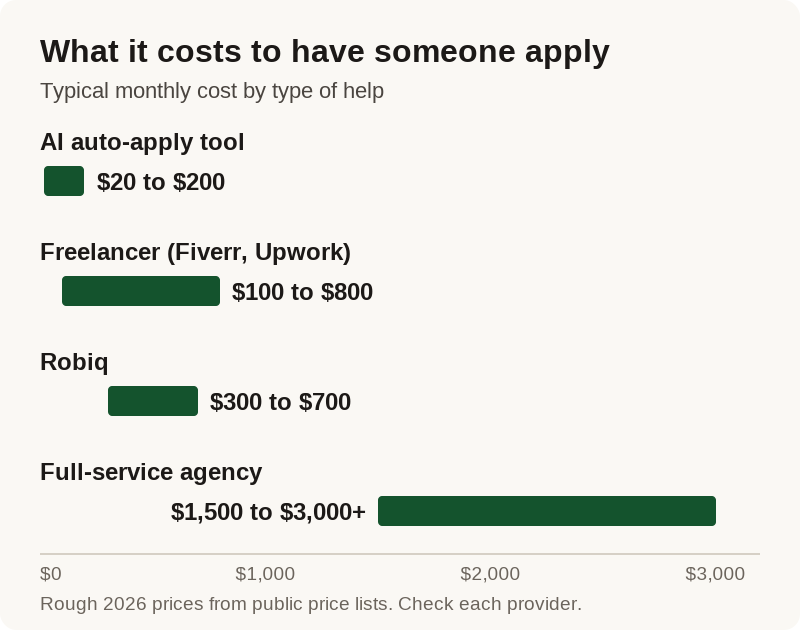
Prices vary a lot, so compare the cost per application and what's included, not just the monthly fee. These are rough 2026 ranges from public price lists.
Option 1: AI auto-apply tools
Software that fills in application forms for you, often hundreds a month. It's the cheapest option per application, but no person reads the job, so many applications go to roles you don't fit, with a resume that isn't tailored. Some job sites also block automated applications.
Good for: entry-level searches where volume matters more than fit. Not good for: senior roles, career changes, or anywhere you only get one chance with a company.
Option 2: a freelancer or virtual assistant
You can hire someone on Fiverr or Upwork to apply for you, usually per gig or by the hour. The quality depends entirely on the person. Some are excellent; many send the same resume everywhere and don't keep a proper record.
If you go this way, write clear rules: your target titles, levels and locations, how many applications a day, which resume to use, and a shared sheet where every application is logged with the job link and date.
Option 3: a reverse recruiting service
A reverse recruiter is a team that runs your search for you: agreeing your targets, finding fresh jobs every day, tailoring your resume for each one, applying and tracking everything. You see every application and spend your own time on interviews.
At Robiq, a one-time trial is $40 for 50 tailored applications. Starter is $300 a month for 150 applications, and Pro is $700 a month for 350 applications plus messages to hiring managers and interview prep. There's no success fee.
Option 4: a full-service agency
Large agencies charge $1,500 to $3,000 a month, and some also take 8% to 10% of your first-year salary when you're hired. They often include coaching and outreach. They can be worth it for senior people, but check the success fee carefully, because on a $150,000 salary 10% is $15,000.
What you should get, whoever you hire
- A conversation about your targets before anything is sent.
- A resume tailored to each job, using only your real experience.
- A tracker with every application, the job link and the date.
- A weekly update on replies and interviews.
- Written prices, terms, and how to stop.
- Your own accounts and passwords kept private. Use a separate job-search email if you can.
How to hand over your job search in 5 steps
- Write your targets: 2 or 3 job titles, level, salary range, locations and visa needs.
- Fix one strong master resume and your LinkedIn profile first.
- Agree how many applications a week and which jobs to skip.
- Share a tracker you can see at any time.
- Review the first 20 to 50 applications together before they scale up.
Red flags
- A guaranteed job offer. No one can promise that honestly.
- Offers to add experience, skills or degrees you don't have.
- No tracker, or a refusal to show you what was sent.
- Thousands of applications for a very low price. That's software sending one resume everywhere.
- Asking for your bank or email passwords.
- A big upfront fee with no trial and no written terms.
My advice
Whoever you hire, the result depends on targeting. The biggest mistake I see is applying to too many jobs without checking whether they're the right fit. Quality matters more than quantity.
For one software engineer we worked with through a US recruiting agency, we narrowed his targets first and applied only to roles that fit. Within one month he had 35 interviews and a contract offer worth $150k a year. That's why our trial is small: 50 applications for $40, so you can see the work before you commit.
Questions
Can I pay someone to apply for jobs for me?
Yes. You can use a freelancer, a virtual assistant, an AI auto-apply tool or a reverse recruiting service. Make sure every application uses your real experience and that you can see what's sent.
How much does it cost to have someone apply for jobs?
Roughly $20 to $200 a month for AI tools, $100 to $800 for a freelancer, $300 to $700 for Robiq and $1,500 to $3,000 or more for a full-service agency in 2026.
Is it legal to have someone apply for jobs on my behalf?
Yes, with your permission and your real details. It isn't OK for anyone to invent experience or pretend to be you in an interview or test.
Will employers know someone else applied for me?
Usually not, and it rarely matters. What employers care about is that the application is accurate and that you're the person who interviews.
Is it better to hire a person or use an AI auto-apply tool?
A person is better when fit matters, because they read each job and tailor your resume. AI tools are cheaper per application but often send generic applications to poor matches.
How many applications should someone send for me each week?
Enough well-matched, fresh jobs to keep your search moving, often 25 to 75 a week depending on your field. More only helps if the jobs really fit.
Can someone guarantee me a job?
No. Employers decide who they hire. At Robiq, if you don't get 3 interviews in your first 3 months on a monthly plan, we refund what you paid, but no one can honestly promise a job offer.