How many applications does it take to get a job?

In 2026, hiring reports and career sites commonly put it at somewhere between 100 and 300 applications for one job offer, and roughly 20 to 100 applications for one interview. Some people need far fewer; some need many more.
The number that really matters is your interview rate: how many interviews you get for every 100 applications. Better-matched jobs and a tailored resume raise that rate, so you need fewer applications, not more.
What the numbers say
Popular job postings now get hundreds of applications each, much more than a few years ago, because applying online is quick and many people use auto-apply tools. Recruiting software companies that publish hiring data report that a typical opening receives around 250 applications, and that it takes a couple of hundred or more applications for each hire.
That doesn't mean you personally need 250 applications. Those averages include everyone who applied without reading the job. If your applications are well matched, you're competing with a much smaller group of serious candidates.
Work out your own number
Work backwards from an offer. Say you need about 6 first interviews to get one offer. That's only an example: it depends on your field and how well you interview. Then divide by your interview rate.
| Your interview rate | Applications for 1 interview | Applications for 6 interviews |
|---|---|---|
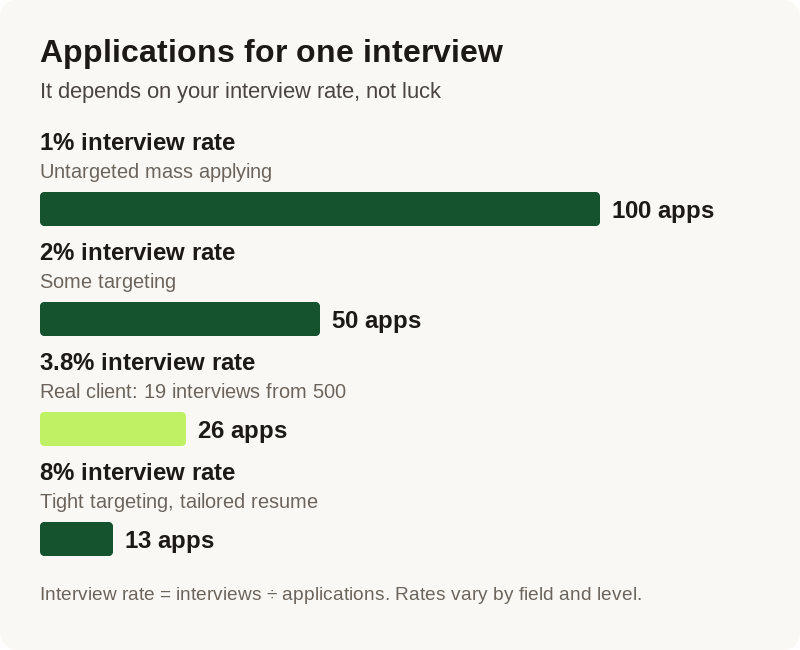
| 1% | About 100 | About 600 |
| 2% | About 50 | About 300 |
| 4% | About 25 | About 150 |
| 8% | About 13 | About 75 |
Why your interview rate matters most
Doubling your interview rate cuts the applications you need in half. That's why sending more of the same applications rarely fixes a slow search, but changing what you send often does.
Real numbers from our clients
For an affiliate marketing manager, 500 applications led to 19 interviews, a 3.8% interview rate, or about one interview for every 26 applications.
Across one US recruiting agency's candidates, our team sent 10,132 applications and received 88 interview requests. That's lower per application, because it covers many fields and levels, including some very competitive ones. Clients from that work were hired at McKesson, CyberMaxx, Twilio and Jacobs.
For one software engineer with a clear target, we narrowed his titles and companies first. Within one month he had 35 interviews and a contract offer worth $150k a year. Targeting made the difference, not volume.
What changes how many applications you need
- Fit: applying to jobs where you meet most of the requirements, at your level.
- Timing: applying in the first few days after a job is posted, before the pile builds up.
- Your resume: tailored to each job's title and key skills, so it passes the first quick read.
- Field and level: entry-level and very popular remote roles get far more applicants.
- Location and visa: jobs that can't sponsor you or need you on site will rarely reply.
- Referrals: a referral can be worth dozens of cold applications.
How many applications per day or week?
For most people, 5 to 15 well-matched applications a day, or about 25 to 75 a week, is plenty. That's enough to keep your search moving while leaving time to tailor your resume and prepare for interviews.
If you're sending 50 a day, check how many of those jobs you'd really accept and could really get. High numbers usually mean the targeting has slipped.
When to stop and review
- After 50 applications with no replies at all: check your targets and resume before sending more.
- Replies but no interviews: your resume or LinkedIn may not match the jobs you're choosing.
- Interviews but no offers: practice interviews and look at which stage you're dropping out.
- Every 2 weeks: compare your interview rate with your own last 2 weeks, not with anyone else.
My advice
The question I'd ask isn't how many applications, it's how many of them were right. The biggest mistake I see is people applying to too many jobs without checking whether they're the right fit. Quality matters more than quantity.
If you've sent 200 applications and heard almost nothing, stop and review before you send 200 more. Narrow your titles, fix your resume for those titles, and apply early to fresh jobs. That's exactly how we work at Robiq, and why our trial is 50 tailored applications for $40, so you can see your interview rate before you commit.
Questions
How many applications does it take to get a job in 2026?
Commonly 100 to 300 applications per offer, but it depends on your interview rate. With well-matched, tailored applications many people need far fewer.
How many applications does it take to get an interview?
Often between 20 and 100. At a 4% interview rate you'd expect about one interview for every 25 applications. One of our clients got 19 interviews from 500 applications, about one in 26.
Is 100 job applications a lot?
Not unusual in 2026. What matters is your result: if 100 well-matched applications brought no interviews, change your targets or resume rather than sending another 100.
How many jobs should I apply to per day?
Around 5 to 15 well-matched jobs a day, or 25 to 75 a week, is enough for most people. More only helps if the jobs really fit.
What is a good interview rate?
Anything above 2% to 3% is reasonable for most online applications, and higher is very good. Compare yourself with your own past weeks, because rates vary by field and level.
Why am I applying to so many jobs and getting no interviews?
Usually it's fit, timing or the resume: jobs slightly above or outside your experience, applying after the first few days, or a resume that doesn't match the job title and skills.
Can a reverse recruiter reduce how many applications I need?
A good one aims to raise your interview rate by choosing better-matched jobs and tailoring your resume for each. No one can honestly promise a set number of interviews or a job.