How to tailor your resume to a job description

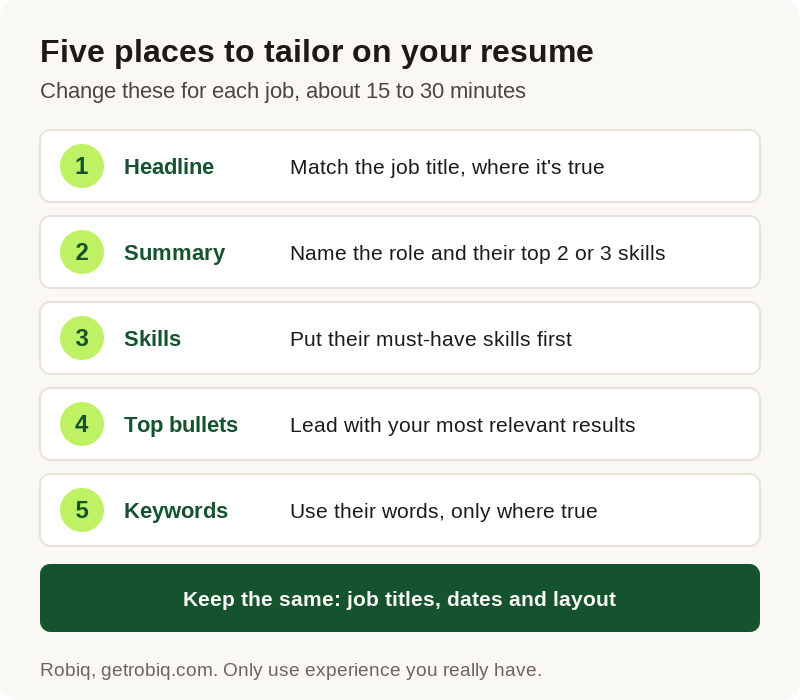
To tailor your resume to a job description, read the posting and mark the job title, the must-have skills and the words that repeat. Then change five things on your resume to match: your headline, your summary, the order of your skills, your top bullet points and the keywords you use. Only use experience you really have.
You don't rewrite the whole resume each time. You keep one strong master resume and adjust the top third of it for each job. With practice it takes about 15 to 30 minutes per application, and it's the single biggest thing we change for our clients.
What tailoring a resume really means
Tailoring means making it obvious, in a few seconds, that you fit this specific job. Recruiters skim. Many companies also use an applicant tracking system (ATS) that sorts resumes by how well they match the job. A generic resume makes both of them guess.
It does not mean inventing skills, copying the job description into your resume or changing your job titles to match. Everything on the page should be true and something you can talk about in an interview.
Step by step: tailor your resume in about 20 minutes
- 1. Read the job description twice. The first time, ask yourself honestly whether you fit. If you meet less than about 70% of the main requirements, it's usually better to skip it.
- 2. Mark three things: the exact job title, the must-have skills or tools, and any words that appear more than once.
- 3. Start from your master resume. Save a copy named with the company and role, so you always know which version you sent.
- 4. Change your headline to the job title (or the closest true version of it).
- 5. Rewrite your summary in 2 or 3 lines: the role, your years of experience, and the 2 or 3 skills this job cares about most.
- 6. Reorder your skills and your bullet points so the most relevant ones come first. Cut or shorten what doesn't matter for this job.
- 7. Use their words where they are true for you. If they say 'stakeholder management' and you wrote 'worked with clients', use their phrase.
- 8. Read it once as the recruiter. In the top third of the page, can you see why you fit in under 10 seconds?
What to change and what to keep
Most of your resume stays the same. Focus your time on the parts recruiters read first.
| Part of your resume | Change it for each job? | What to do |
|---|---|---|
| Headline or title line | Yes | Match the job title where it's true |
| Summary | Yes | Name the role and the 2 or 3 skills they want most |
| Skills section | Yes, the order | Put their must-have skills first |
| Bullet points | Yes, the top 2 or 3 | Lead with your most relevant results |
| Job titles and dates | No | Never change these to fit a job |
| Education and certificates | Rarely | Move up only if the job asks for them |
| Contact details and format | No | Keep one clean, simple layout |
A before and after example
Say the job is a Senior Digital Marketing Manager role that asks for paid social, budget ownership and reporting to leadership.
Before: 'Managed social media campaigns for several brands and helped grow engagement.'
After: 'Owned a paid social budget across Meta and LinkedIn for 4 brands, cutting cost per lead and reporting results to the leadership team each month.'
Nothing new was invented. The second version uses the job's own words (paid social, budget, leadership), puts the relevant part first, and says what you owned. If you have a real number, such as how much the cost per lead dropped, add it.
Keywords and applicant tracking systems
An ATS reads your resume as text and compares it with the job. Hiring reports and recruiters commonly say that simple layouts and the job's own words help your resume get read correctly.
- Use a simple, one-column layout. Avoid text inside images, tables for layout, and headers or footers holding key details.
- Spell out terms once, then use the short form: 'search engine optimization (SEO)'.
- Use standard section names: Summary, Experience, Skills, Education.
- Save as PDF unless the job asks for Word.
- Don't hide keywords in white text or stuff a list of every buzzword. Recruiters notice, and it reads badly.
Can you tailor a resume with AI for free?
Yes. Free AI chat tools can compare your resume with a job description and suggest which skills and words to bring forward. It's a useful first draft, especially when you're applying a lot. Auto-apply tools go a step further and send the applications for you, usually with a lightly edited, generic resume. Our guide on whether AI can apply to jobs for you covers where they help and where they don't.
- Paste the job description and your resume, and ask: 'Which of my real experience matches this job best, and which keywords am I missing?'
- Tell it not to add skills or results you don't have. AI tools will happily invent them.
- Rewrite the suggestions in your own words. Recruiters are getting good at spotting generic AI phrasing.
- Check every line. You need to be able to explain each one in an interview.
Common mistakes
- Sending one generic resume to every job.
- Tailoring for jobs you don't really fit. No amount of editing fixes the wrong target.
- Adding skills you don't have because the job lists them.
- Changing past job titles to match the new role.
- Losing track of which version went to which company, then being surprised by questions in the interview.
- Spending an hour on design and two minutes on the words.
- Never checking your interview rate. If 50 tailored applications bring no replies, the target or the resume needs work before you send more.
My advice
Tailoring is the work I spend the most time on when I apply for our clients, and it's where I see the biggest difference. But it comes second. First, check the job is the right fit. The biggest mistake I see is people applying to too many jobs without checking whether they fit, then wondering why nothing comes back.
For one software engineer we worked with through a US recruiting agency, we picked his target roles first and tailored his resume for each one. Within one month he had 35 interviews and a contract offer worth $150k a year. That came from targeting plus tailoring, not from sending more. If you've applied a lot with no replies, stop and review your resume and targets before you send the next batch. Our guide on how to get more interviews walks through that review.
If you don't have the time, this is what a reverse recruiter like Robiq does: we find fresh jobs that fit you and tailor your resume for each one, using only your real experience. Our $40 trial is 50 tailored applications. We can't promise a job, because employers decide who they hire, but we can make sure every application is a good one.
Questions
How do I tailor my resume to a job description?
Mark the job title, must-have skills and repeated words in the posting. Then update your headline, summary, skills order, top bullet points and keywords to match, using only experience you really have.
How long should it take to tailor a resume?
About 15 to 30 minutes once you have a good master resume. You only change the top third of the page and the order of your skills and bullets.
Should I tailor my resume for every job?
Yes, for every job you really want. A tailored resume makes your fit clear in seconds. If a job isn't worth 15 minutes of tailoring, it may not be worth applying to.
Is it OK to copy words from the job description?
Use their words for skills and experience you really have, such as the same tool names and phrases. Don't paste whole sentences or list skills you don't have.
Can I use AI to tailor my resume for free?
Yes. Free AI chat tools can compare your resume with a job and suggest changes. Tell it not to invent anything, rewrite the result in your own words, and check every line.
Does tailoring help with applicant tracking systems?
Usually, yes. Using the job's own words and a simple one-column layout helps an ATS read and match your resume. Hidden keywords or keyword stuffing don't help.
Should I change my job titles to match the job?
No. Keep your real job titles and dates. You can match the job title in your headline and summary if it truly describes what you do.