15 job search tips that actually get interviews

The job search tips that make the biggest difference in 2026 are simple: pick 2 or 3 clear target roles, tailor your resume to each job, apply within the first few days of a posting, ask for referrals, and track every application so you can follow up and see what's working.
Sending more applications only helps once those basics are right. Below are 15 tips from our own work applying for job seekers, grouped by stage, plus a simple weekly routine you can copy.
Before you apply
- 1. Pick 2 or 3 target job titles. Write down the titles, level, salary range, locations and whether you need visa sponsorship. Everything else follows from this.
- 2. Build one strong master resume. Lead with results, use numbers you can explain, and keep it to one or two pages.
- 3. Match your LinkedIn to your targets. Use your target title in your headline, add the key skills, and turn on Open to Work (set it to recruiters only if you still have a job).
- 4. Make a list of 30 to 50 target companies. Check their career pages weekly, not just the big job boards.
Finding the right jobs
- 5. Set job alerts for your exact titles. Daily alerts on LinkedIn, Indeed and company sites help you see new jobs first.
- 6. Apply in the first few days. Popular jobs fill up fast, and early applications are more likely to be read.
- 7. Skip jobs you don't fit. If you meet less than about 70% of the main requirements, or the job can't sponsor you, move on.
- 8. Ask for referrals. A short message to someone at the company, naming the exact job, often gets your resume read by a person.
Applying
- 9. Tailor your resume to every job. Match the job title, put the most relevant achievements first and use the job's key words where they're true for you.
- 10. Keep cover letters short. Three short paragraphs: why this job, your best matching result, and a simple close. Many jobs don't need one at all.
- 11. Track every application. Keep the job link, date, resume version and status in one sheet. You can't follow up or prepare for what you can't see.
After you apply
- 12. Follow up once after about a week. A polite message to the recruiter or hiring manager is enough. Don't chase daily.
- 13. Practice your interview stories. Prepare 5 short stories about results you're proud of, and practice them out loud.
- 14. Review your numbers every 2 weeks. If 50 applications bring no replies, change your targets or resume before sending more. Our guide to how many applications it takes shows how to work out your own number.
- 15. Protect your energy. Set fixed hours, take days off, and remember that rejections are usually about fit and timing, not your worth.
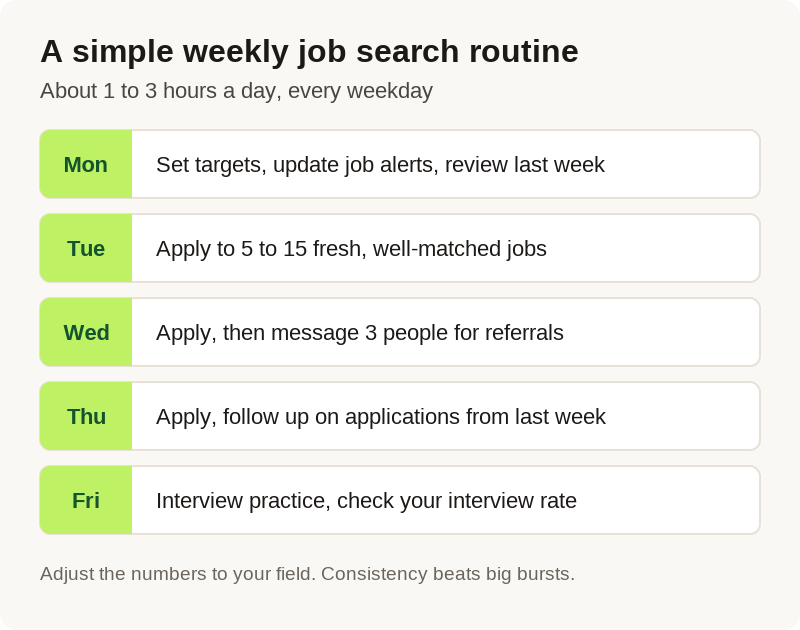
A simple weekly routine
A steady routine beats big bursts followed by burnout. This is the kind of week we'd suggest for most people searching full time. If you're working, halve the numbers.
LinkedIn job search tips
- Use your target job title in your headline, not just your current title.
- Filter searches by date posted (past 24 hours or past week) and save the search with alerts on.
- Check who posted the job or who works on that team, and send a short, specific note.
- Easy Apply jobs get the most applicants. Applying on the company's own site can help you stand out.
- Post or comment once or twice a week about your field so recruiters see recent activity.
Remote job search tips
- Check where the job is open to. Many 'remote' jobs are remote only within one country or time zone.
- Say clearly on your resume and LinkedIn which time zones you can work in.
- Expect more competition. Remote jobs attract far more applicants, so tailoring and applying early matter even more.
- Show you work well remotely: name the tools you use and results you delivered without being in an office.
Common mistakes
- Applying to everything with one generic resume.
- Applying weeks after a job was posted.
- Not tracking applications, so you can't follow up or prepare.
- Only using job boards and never asking for referrals.
- Sending hundreds more applications instead of fixing what isn't working.
My advice
If I could give one tip, it would be this: quality over quantity. The biggest mistake I see is applying to too many jobs without checking whether they're the right fit. Targeting comes first, then volume.
For one software engineer we worked with through a US recruiting agency, we narrowed his targets first and applied only to roles that fit. Within one month he had 35 interviews and a contract offer worth $150k a year. For an affiliate marketing manager, 500 well-matched applications led to 19 interviews.
If you'd rather have a team do the searching and applying, that's what a reverse recruiter like Robiq does, and our guide to whether reverse recruiting is legit explains what to check first. Our trial is 50 tailored applications for $40, so you can see the quality before you commit. We never promise a job, but we do promise to apply carefully.
Questions
What is the best job search tip?
Get clear on 2 or 3 target roles and tailor your resume to each job. Most slow searches come from applying to too many poorly matched jobs with a generic resume.
How many hours a day should I spend job searching?
Around 1 to 3 focused hours a day is enough for most people searching full time. Fixed hours and days off help you avoid burnout.
How many jobs should I apply to a day?
About 5 to 15 well-matched jobs a day, or 25 to 75 a week, for most people. More only helps if the jobs really fit you.
What are good LinkedIn job search tips?
Put your target title in your headline, filter by date posted, save searches with alerts, and send short, specific messages to people on the hiring team.
How do I find remote jobs?
Search with remote filters on major job boards, check where each job is open to, state your time zones clearly, and apply early because remote roles attract many applicants.
Should I follow up after applying for a job?
Yes, once, about a week after applying. A short, polite message to the recruiter or hiring manager is enough.
Why am I not getting interviews?
Usually it's fit, timing or the resume. Check that you meet most of the requirements, apply in the first few days, and tailor your resume to the job title and key skills.